What Is Floor Shot Blasting and Why It’s the Gold Standard for Concrete Preparation
Floor shot blasting is a high-efficiency, dust-controlled method of preparing concrete by propelling steel abrasive at the surface and instantly reclaiming the media and dust. This controlled impact breaks open the top layer of laitance, removes weak cement paste and contaminants, and creates a clean, textured profile—often referred to as a mechanical key—that dramatically improves adhesion for new coatings and screeds. Because the system is enclosed and paired with powerful vacuum recovery, the process is exceptionally clean compared to open blasting or wet methods, keeping operations moving in sensitive or occupied environments.
Shot blasting is uniquely capable of producing a consistent surface profile across large areas, making it ideal for industrial floors that demand durability and uniform performance. By choosing the appropriate shot size and machine settings, technicians can target specific Concrete Surface Profile (CSP) ranges—commonly CSP 2–4 for resin coatings and CSP 3–5 for thicker trowel-applied or heavy-duty systems. This level of control helps ensure that epoxy coatings, polyurethane screeds, and other industrial resin floors chemically bond and mechanically lock to the substrate, reducing the risk of peeling, blistering, or premature failures.
Unlike some grinding-only approaches, shot blasting doesn’t merely “polish” or smear fines across the surface. It opens the pores of the concrete, allowing primers and resins to penetrate fully. The result is an optimal adhesion plane that supports higher pull-off strengths and longer service life, even under aggressive material handling equipment (MHE) traffic. It’s also an efficient choice: modern ride-on and walk-behind shot blasters can process significant square meterage per shift, frequently outpacing alternative methods while minimizing disruption and turnaround times.
Another key advantage is environmental performance. Shot blasting is a dry process—no water, no slurry, and dramatically reduced waste. The steel abrasive is recyclable and continually recirculated inside the machine, while integrated dust extraction captures fine particulates at source. For facilities that must manage hygiene, air quality, or contamination risks, a dust-controlled, closed-loop preparation method offers tangible compliance and housekeeping benefits without sacrificing speed or quality.
Where Shot Blasting Excels: Typical Projects, Specifications, and Preparation Detail
Because it delivers a repeatable, high-quality substrate, floor shot blasting is the preferred preparation for a wide range of industrial and commercial settings. New-build projects use it to remove curing agents, mill-scale, and surface inconsistencies before resin installation. Refurbishment programs rely on it to remove line markings, failed coatings, light oil staining (when paired with degreasing), and brittle surfaces, making way for high-build epoxy systems, anti-static floors, and heavy-duty polyurethane screeds that handle impact, abrasion, and thermal shock.
Common scenarios include logistics and warehousing (where forklift traffic demands robust adhesion), production plants and engineering workshops (requiring abrasion resistance and chemical durability), food and beverage facilities (where hygiene, cleanability, and slip resistance are critical), pharmaceuticals and cleanrooms (where low-dust, tightly controlled preparation is essential), and multi-storey car parks (needing reliable bond strength for deck membranes and waterproofing systems). In each case, shot blasting can be tailored to the specification—whether that’s a CSP 2–3 for self-smoothing epoxy, CSP 3–4 for high-build coatings, or a more aggressive profile ahead of a 6–9 mm polyurethane screed.
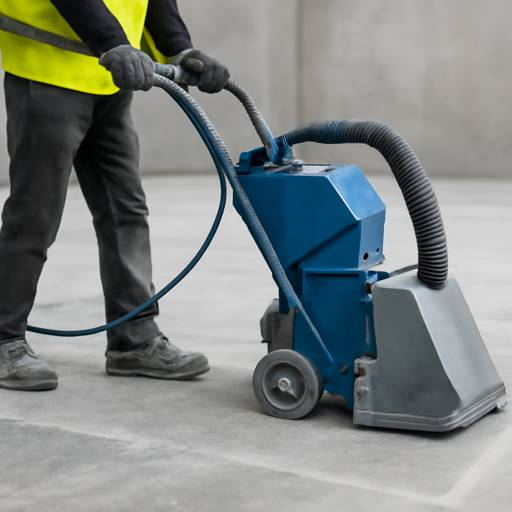
A well-executed preparation program starts with a site survey and testing plan. Moisture readings (e.g., in-situ RH), contamination checks, and substrate strength assessments help define the correct approach. Method statements then set target profiles, machine settings, and coverage rates. During blasting, technicians control feed rate, travel speed, and shot size to achieve the desired texture without gouging or over-exposure of aggregate. Edges, tight areas, and around columns are addressed with small-format shot blasters or compatible diamond tooling to maintain continuity. Joints and cracks are chased and repaired after blasting, ensuring the coating or screed system sits on a continuous, well-keyed surface.
Cleanliness between preparation and installation is equally important. Even though shot blasting reclaims dust at source, final HEPA vacuuming and housekeeping ensure that no loose debris remains. Primers are applied within the recommended window to exploit the freshly opened surface, preventing recontamination. When the specification demands, anti-static or moisture-tolerant primers can be integrated without compromising the mechanical bond provided by the blasted profile. In time-pressured programs—night works, weekend turnarounds, or phased production shutdowns—this disciplined, dust-controlled workflow keeps downtime to a minimum while safeguarding coating performance.
Performance, Safety, and ROI: What to Expect from Professional Shot Blasting on UK Sites
Professional shot blasting delivers measurable outcomes that translate directly into reliability and value. A correctly blasted substrate often achieves pull-off adhesion values that significantly exceed the minimums recommended for industrial resin floors, helping coatings reach their full design life under heavy traffic and harsh cleaning regimes. Fewer adhesion-related callouts mean lower lifecycle costs, and the speed of the process reduces the window of disruption to operations.
In real-world terms, production rates for modern equipment can reach thousands of square meters per day under suitable site conditions, allowing large warehouses or manufacturing halls to be prepared, coated, and returned to service on accelerated schedules. For example, a national distribution hub in the Midlands phased its refurb over two weekends: shot blasting achieved a CSP 3 substrate across expansive aisles and pick zones, enabling rapid application of a high-build epoxy system. The facility resumed Monday operations with a tougher, more uniform floor, and rework metrics dropped sharply in the subsequent maintenance cycle.
In hygiene-critical environments, the benefits are equally clear. A North West food processing area required a heavy-duty polyurethane screed with enhanced slip resistance. The concrete was blasted to a CSP 4, ensuring deep mechanical anchorage for the 6 mm screed. The result was a robust, easy-to-clean surface that withstood hot washdowns and constant traffic without edge curling or early debonding. Similarly, a multi-storey car park in the South East used shot blasting to remove weathered coatings and open the concrete for a new polyurethane deck system, improving waterproofing integrity and reducing future patch repairs.
Safety and compliance are integral to the process. Shot blasting’s enclosed system and H-class extraction minimize airborne dust, supporting site-specific risk controls and helping align with best practice for air quality and housekeeping. With recyclable steel media and no chemical slurry, waste is reduced and cleanup is faster—an environmentally conscious advantage as sustainability targets tighten. Noise is managed through scheduling and the use of modern, well-maintained machines, and exclusion zones protect adjacent workflows while preparation is underway.
Crucially, shot blasting integrates seamlessly with epoxy coatings, polyurethane screeds, ESD floors, and rapid-cure systems, forming the backbone of a complete resin flooring solution across the UK’s industrial estate. If you’re planning a refurbishment, expansion, or new-build fit-out and need a dust-controlled, specification-driven substrate that maximizes adhesion and uptime, explore professional Floor shot blasting services to set your project up for success from the ground up.

Busan environmental lawyer now in Montréal advocating river cleanup tech. Jae-Min breaks down micro-plastic filters, Québécois sugar-shack customs, and deep-work playlist science. He practices cello in metro tunnels for natural reverb.
0 Comments